Skip to content
Why Solar Street Lights Fail in Real Projects
Solar street lights often perform well in early tests. Problems usually appear months or years later.In many outdoor projects, the main issue is not LED quality, battery size, or controller settings. The real problem is panel contamination. Dust, organic residue, oil particles, and airborne waste slowly cover the solar panel surface. When this happens, energy collection drops day by day.
This problem is very common in agricultural and industrial areas. In self cleaning street light palm oil environments, oil mist and organic waste stick to the panel surface. Rain alone cannot remove them. Over time, the system becomes unstable, even if all electrical parts are still working.
Manual cleaning sounds simple, but in large projects it is difficult to manage. Roads are long, access is limited, and maintenance costs increase every year. This is why self-cleaning solar street lights were developed.
They are not designed to be “smart features.” They are designed to solve a real operational problem.
What Are Self-Cleaning Solar Street Lights?
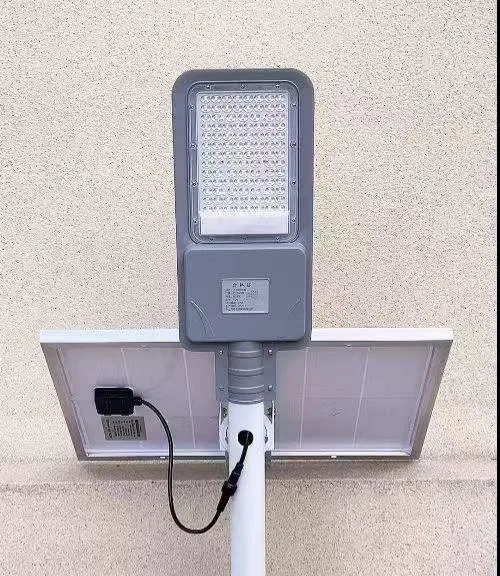
A self-cleaning solar street light is an automatic solar street light that can clean its own solar panel without human help.
The system includes:
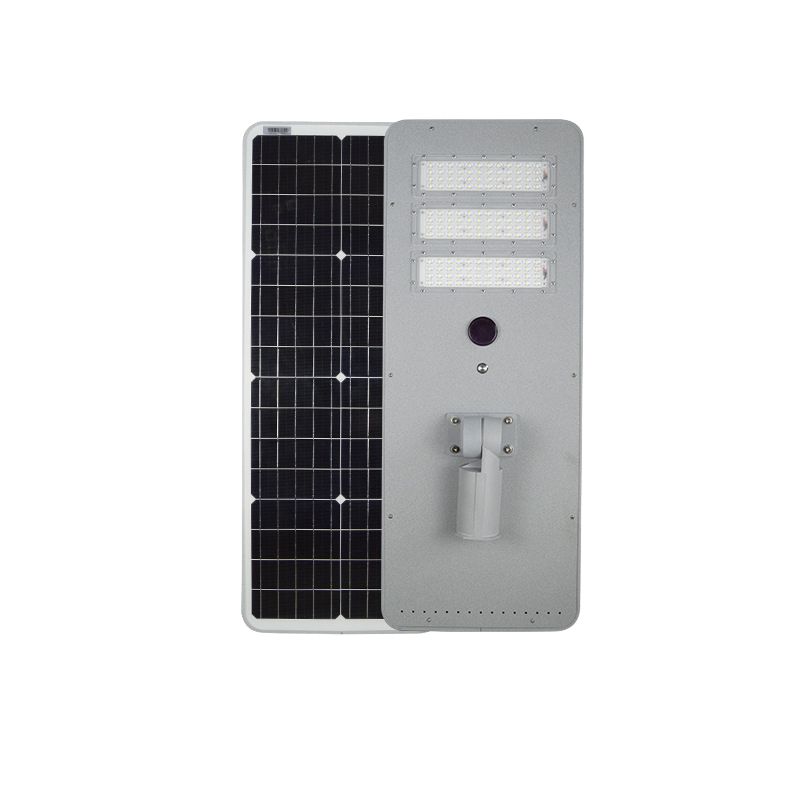
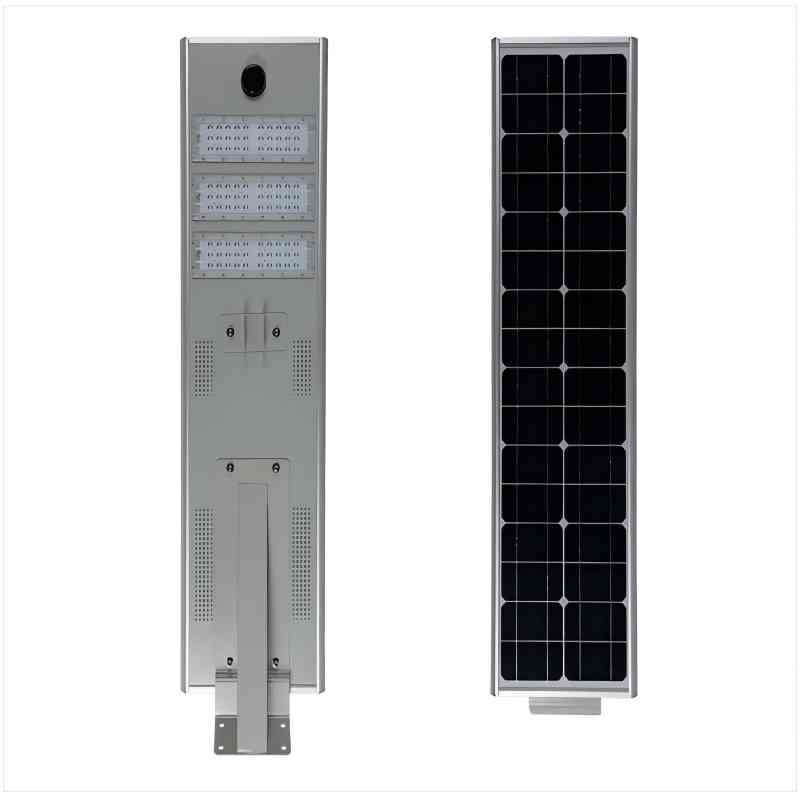
A standard solar lighting structure (panel, battery, controller, LED)
A built-in cleaning mechanism
Control logic to manage cleaning time and energy use
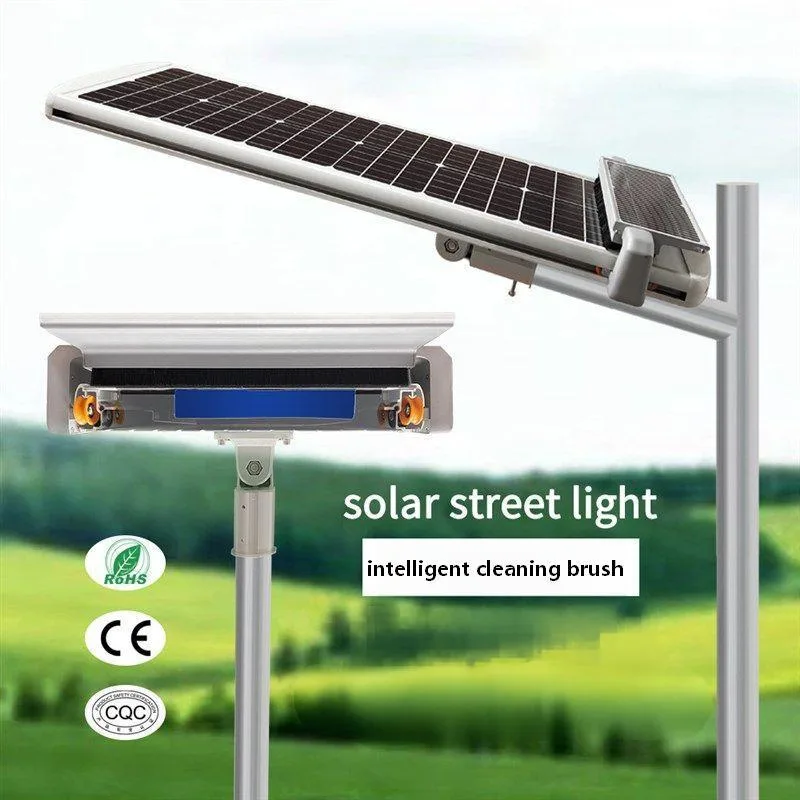
The goal is simple: keep the panel surface clear enough to maintain stable energy input.This is especially important in environments where contamination happens every day. In self cleaning streetlight oil palm waste areas, dirt and oil return quickly after rain. Without active cleaning, performance drops again in a short time.Self-cleaning systems do not try to make the panel perfectly clean. They focus on preventing long-term efficiency loss.
Why Oil Palm and Dust-Heavy Areas Need Self-Cleaning Systems
Oil palm plantations create special conditions for solar lighting.
Organic waste, fine dust, pollen, and oil particles combine into a sticky layer on glass surfaces. This layer reduces light transmission and blocks solar energy. Over time, batteries discharge deeper and age faster.
This is why oil palm self-cleaning street light project deployments exist. They are not experimental ideas. They are responses to real operating conditions.
In many plantation roads:
Lighting poles are spread over long distances
Manual access is limited
Maintenance schedules are difficult to control
A self cleaning street light palm oil project helps stabilize energy collection and reduce human dependency. Over a full operating cycle, this often lowers total ownership cost, even if the initial price is higher.
Many oil palm self cleaning street light project oil palm cases show the same pattern: stable output matters more than peak brightness.
How Self-Cleaning Solar Street Lights Work
Most self-cleaning systems use simple mechanical cleaning.
A small motor moves a brush or wiper across the panel surface. The movement removes dust and breaks up sticky residue. Cleaning is usually scheduled during early morning or evening, when solar input is low.
The system controller decides:
When to clean
How often to clean
How much energy can be used safely
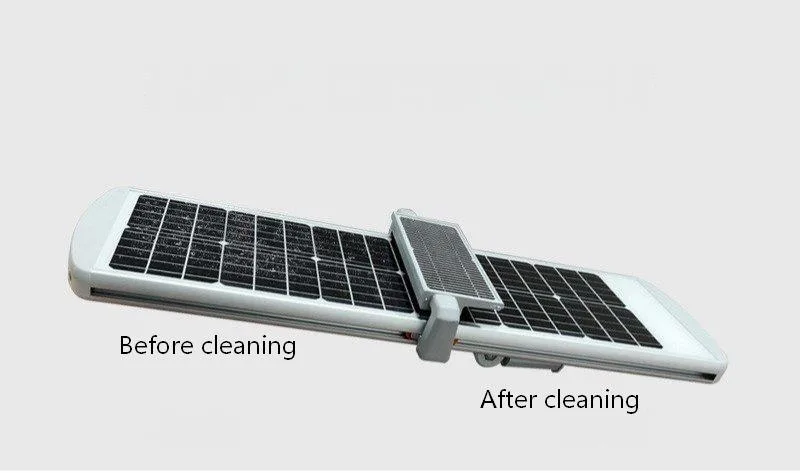
Good designs keep energy use low. In most cases, the energy gained from a cleaner panel is higher than the energy used for cleaning.Because moving parts are involved, reliability is important. This is why self cleaning street lamp research dust resistant lamp project exist. These projects test long-term performance under real dust and pollution, not laboratory conditions.
Self-Cleaning vs Other Cleaning Methods
Manual cleaning is common, but it has limits:
High labor cost
Safety risks
Irregular schedules
Poor consistency
In some controlled environments, robots are used. For example, a robot for cleaning lighting fixtures in highway tunnels works well because tunnels are closed systems with easy access.
However, robots are usually not suitable for:
Rural roads
Plantation networks
Standalone solar poles
Self-cleaning solar street lights solve the problem at the fixture level. Each pole manages its own maintenance. This approach works better in large, open, and remote areas.
When Self-Cleaning Solar Street Lights Make Sense
Self-cleaning systems are not needed everywhere. They should be used when conditions justify them.
They make engineering sense when:
Dust or residue is constant
Rain cannot clean panels effectively
Manual maintenance is costly or unsafe
Project scale increases operational risk
They may not be necessary in clean urban areas with easy access.
The key point is this:
self-cleaning solar street lights are not about adding features. They are about reducing dependency on maintenance.
Conclusion A Practical Solution for Harsh Environments
Self-cleaning solar street lights are a system-level solution to a system-level problem.In oil palm plantations, industrial zones, and dust-heavy regions, contamination limits solar performance more than hardware quality. In these environments, self-cleaning systems help maintain stable energy input, protect batteries, and reduce long-term cost.They are not universal solutions. But where maintenance is the weakest link, they are not optional upgrades. They are practical engineering tools.
FAQ
Do self-cleaning solar street lights improve energy performance?
Yes, but not by increasing peak output.
Their main benefit is stable energy collection over time.
By keeping the solar panel surface clear, the system maintains consistent daily charging. In dust-heavy or oil palm environments, this prevents gradual energy loss, protects the battery, and keeps lighting output stable across seasons.
Are self-cleaning solar street lights suitable for every project?
No. They are not designed for all locations.
They are most suitable when:
Dust, oil mist, or organic residue is continuous
Rain cannot clean panels effectively
Manual maintenance is difficult, unsafe, or expensive
Project size increases maintenance risk
In clean urban areas with easy access, standard solar street lights are often sufficient.
How reliable are self-cleaning mechanisms over long-term use?
Reliability depends on system design, not the idea of self-cleaning itself.
Well-designed systems use:
Simple mechanical movement
Low cleaning frequency
Sealed components for outdoor operation
This is why dust-resistant lamp research and field projects exist—to confirm performance under real operating conditions, not only in labs.
How often does the cleaning system operate?
Cleaning frequency is limited and controlled.
Most systems operate:
Once per day or less
During early morning or evening
Only when battery reserve allows
The goal is to prevent buildup, not to keep the panel perfectly clean. In most cases, recovered energy exceeds cleaning energy use.
How does self-cleaning compare with manual or robotic cleaning?
Manual cleaning involves:
High labor cost
Safety risks
Inconsistent results
Robotic systems, such as robots used to clean lighting fixtures in highway tunnels, work well in controlled spaces. However, they require infrastructure and are not practical for rural roads or plantation networks.
Self-cleaning solar street lights manage cleaning at each pole, making them more suitable for large, remote, and distributed projects.
Does a self-cleaning system significantly increase project cost?
It increases initial cost, but not always total project cost.
In oil palm and dust-intensive environments, fewer maintenance visits, longer battery life, and stable lighting performance often offset the added system cost. The key question is not whether it is cheaper, but whether it is sustainable to operate.
CTA Engineering Support for Harsh-Environment Solar Lighting Projects
If your project is located in oil palm plantations, industrial zones, or dust-intensive areas, lighting performance should be evaluated at the maintenance and lifecycle level, not only by wattage or lumen output.
Our engineering team supports:
Application-specific system selection
Maintenance risk assessment
Long-term performance planning for harsh environments
If you want to review whether a self-cleaning solar street light is technically appropriate for your project, we welcome a project-level discussion.