Skip to content
An Engineering-Level Guide for Modern LED Lighting Projects
For a long time, people used wattages of light bulbs as a quick way to guess brightness.
A 40-watt bulb seemed dim. A 60-watt bulb felt normal. A 100-watt bulb felt bright.
So many users, engineers, and buyers believed watts showed how much light a lamp made.
That rule does not work anymore.
In modern lighting—especially with LEDs –This is why questions like does wattage determine brightness are no longer valid in real projects.Mixing them up is still a common cause of poor lighting results, wasted energy, and expensive redesigns in commercial, industrial, and municipal projects.
So today, which matters more: watts or lumens?
From an engineering view, the answer has nuance: both matter.
But when you compare brightness and what people actually see, lumens matter much more.
This article explains why. It uses a system-level view that connects watts → lumens → lux, and shows how professionals specify lighting correctly in real projects.
What Wattage Really Means in Lighting Systems
What does watts mean for light bulbs?Wattage measures power use, not brightness. Watts tell you how much electricity lumens light fixtures uses from the power system. They do not tell you how much visible light it gives off. If you want to compare brightness, you should look at lumens, not watts. (ENERGY STAR; U.S. Department of Energy)
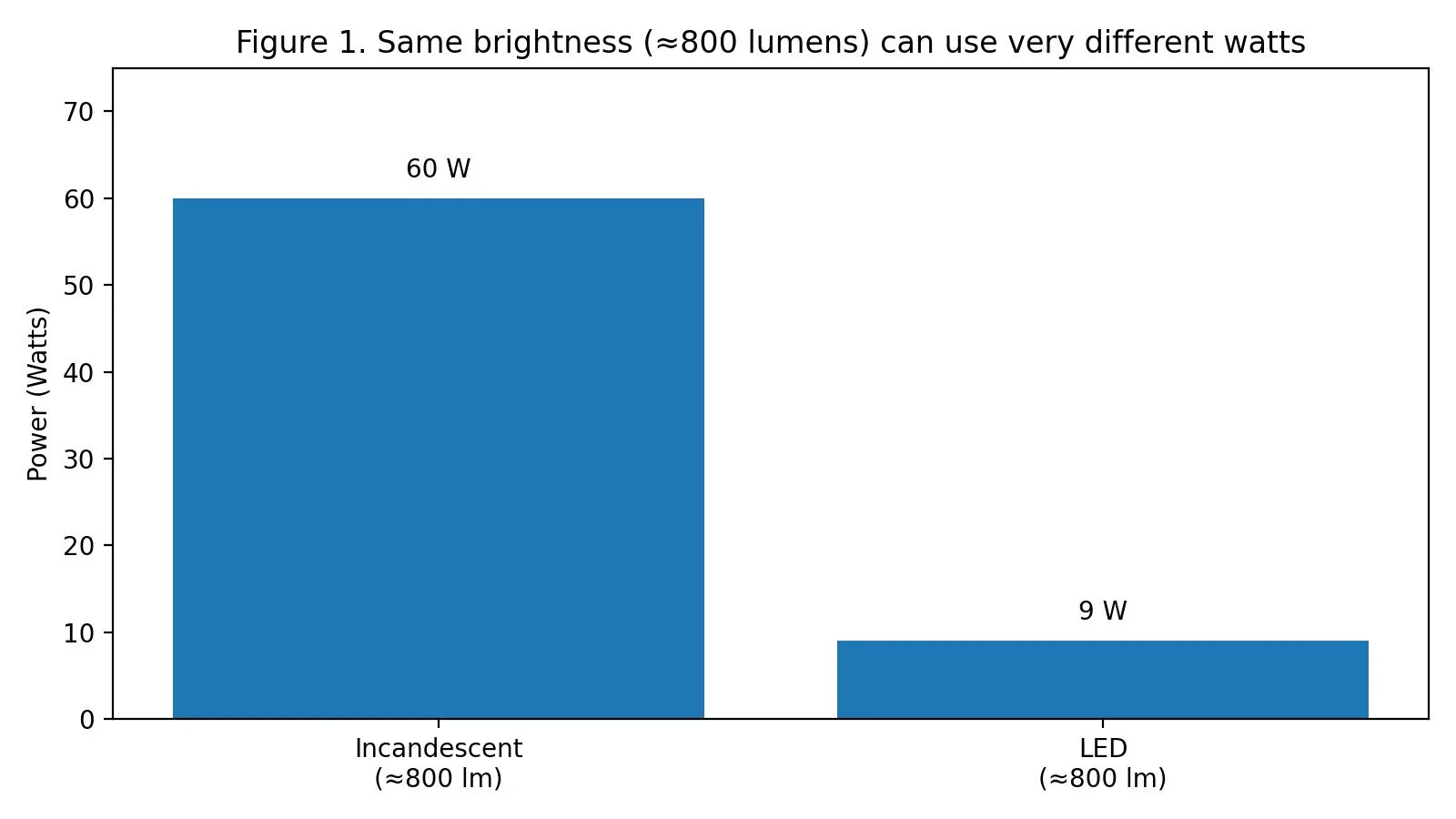
What wattage helps you check (engineering use). Wattage is useful for planning the electrical side of a project. It helps you confirm whether the circuit, breaker, cable, and transformer can handle the load. It also helps you estimate running cost, because higher watts usually mean higher energy use over time. And it helps you judge whether a system is realistic for solar power, battery backup, or a generator.
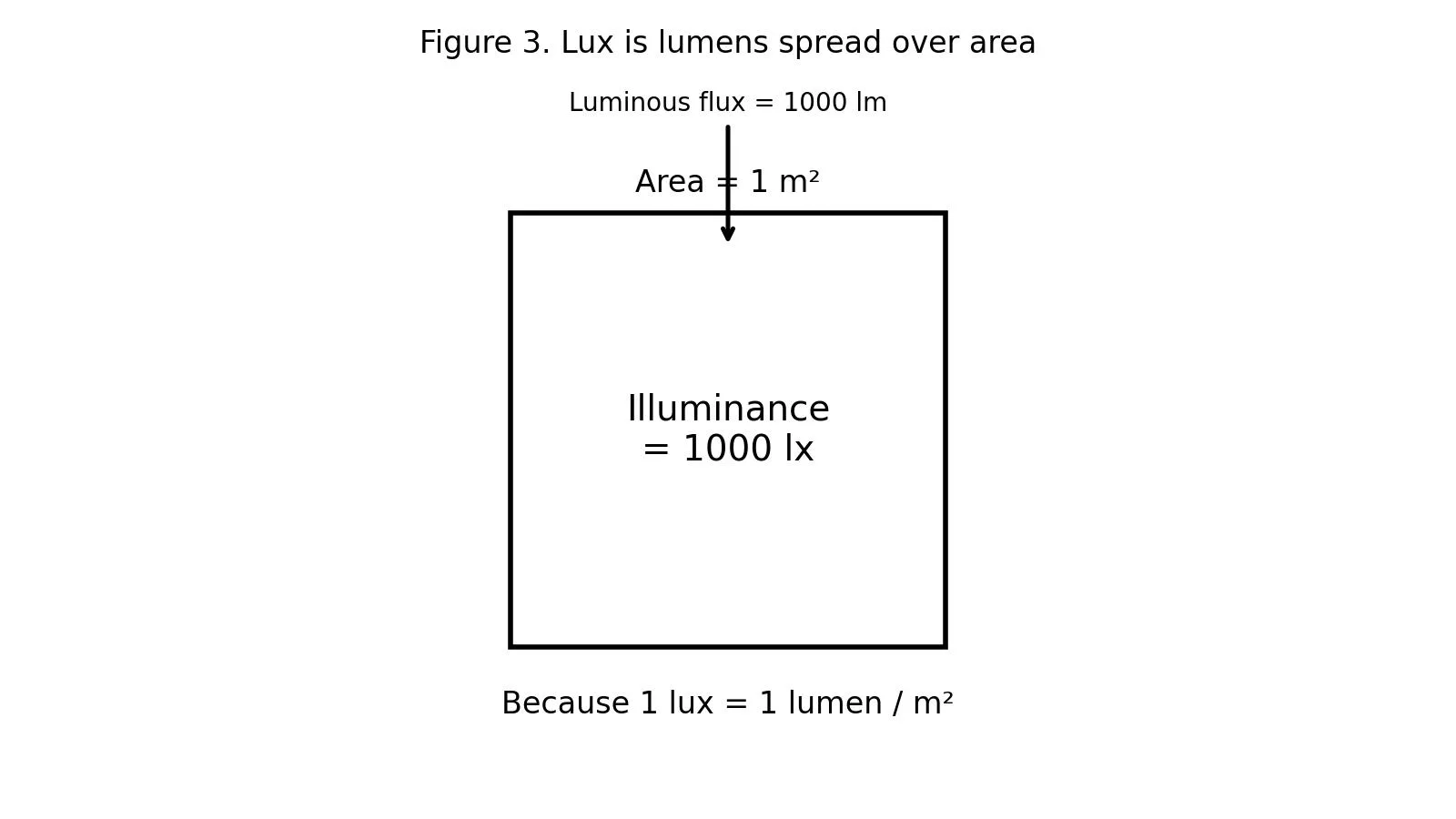
What wattage does NOT tell you. In the watts vs lumens discussion, wattage does not describe how bright a light appears. Light output is measured in lumens, not watts. (ENERGY STAR)It also does not indicate how bright the illuminated surface will be, which is defined by illuminance (lux), where 1 lux equals 1 lumen per square meter. (CIE)This is the core difference in any lumens vs watts comparison: wattage measures power input, while brightness depends on lumens, optics, and layout.
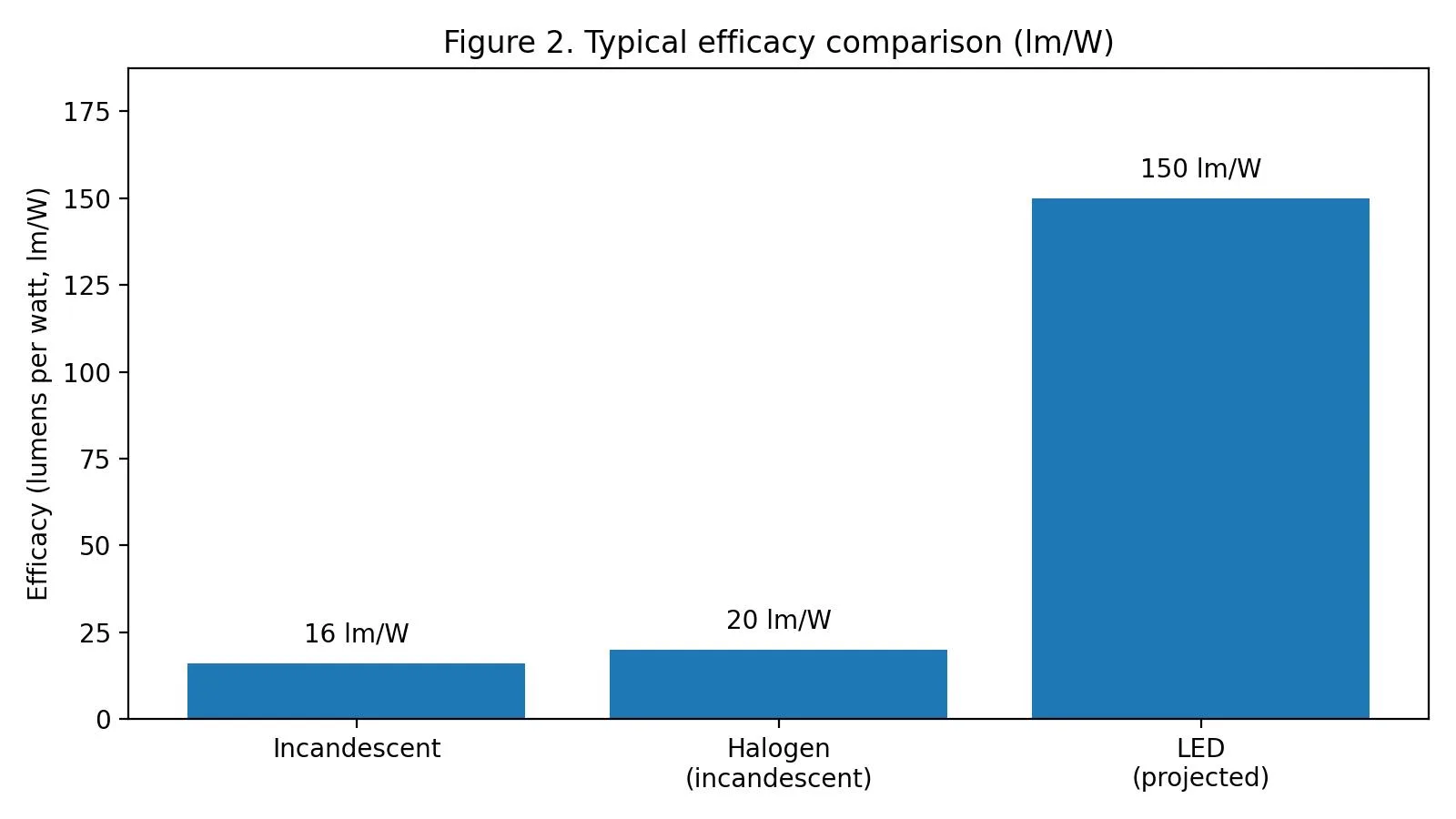
Why watts used to “feel like” brightness. In the past, older lamps—especially incandescent—were very inefficient, and many products had similar efficacy. A typical 60W incandescent is about 16 lm/W, and halogen is often around ~20 lm/W. So when people chose a higher wattage, they often got slightly more light. (U.S. EIA) But this historical behavior shaped the common assumption behind incandescent bulb watts vs lumens, but it was never a physical rule.
Why LEDs changed the rule. LEDs break this link.In led watts vs lumens comparisons, LED products can deliver the same lumen output with much less power. In common comparisons, LEDs often use around 75% less energy than incandescent for similar light levels. (U.S. DOE) That is why wattage vs lumens is no longer a reliable shortcut for brightness.
What Lumens Actually Measure (and Why They Matter More)
what does lumen mean in lighting ?Lumens measure visible light output. They describe the total light a source emits (luminous flux). In simple terms, lumens answer one question: How much light does this fixture actually produce?
That is why modern lighting labels, specifications, and many tenders focus on lumens for brightness—not watts. Watts tell you power consumption; lumens tell you light output.
Here is what this looks like in real products:
100 watt incandescent lumens gives off about 1,600 lumens of light.
A 15W LED bulb can produce a similar ~1,600 lumens (a “100W replacement”).
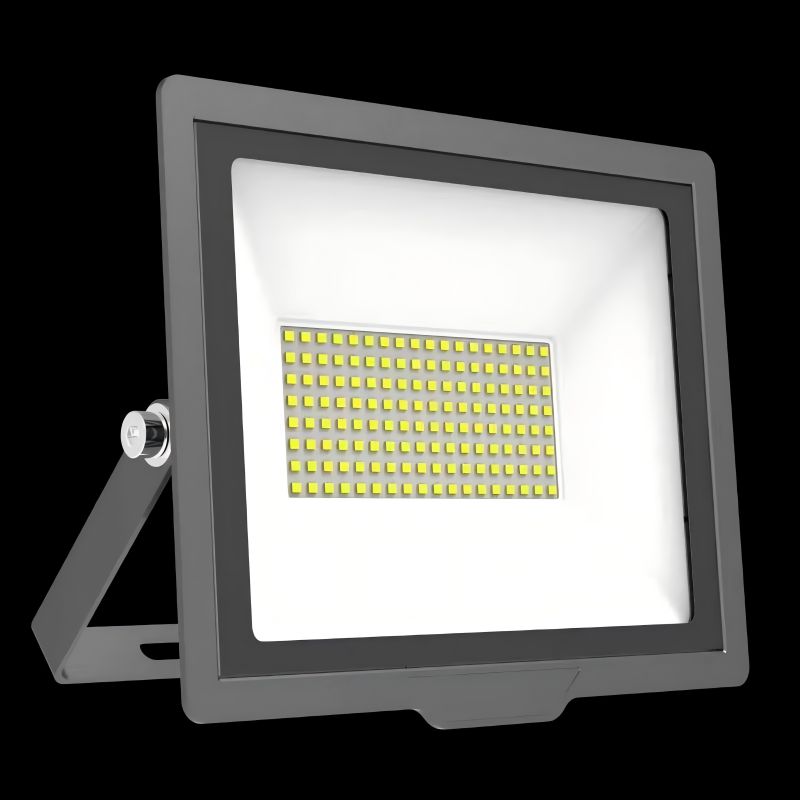
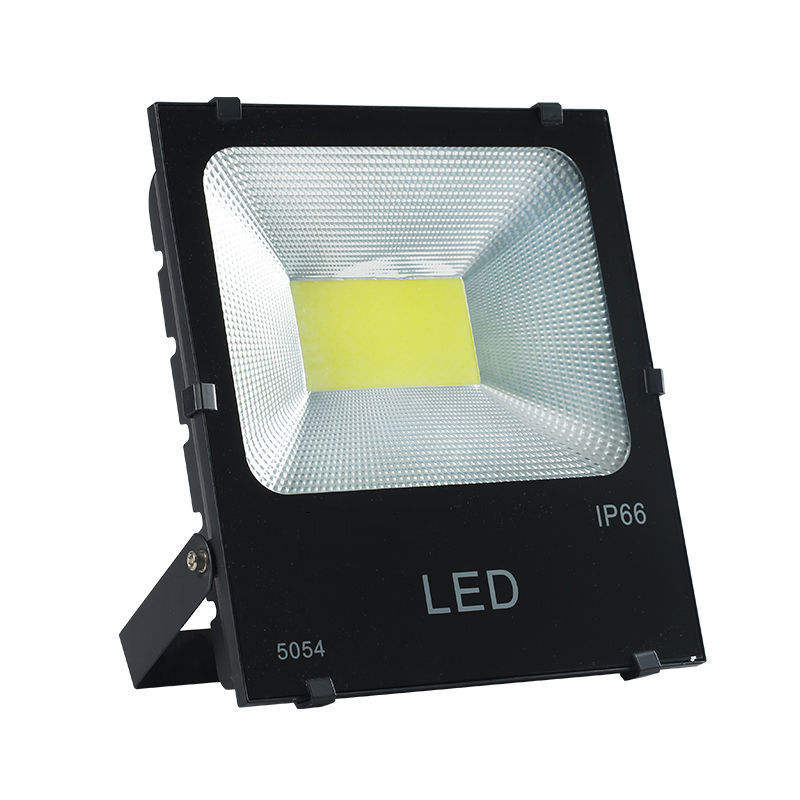
A 100W LED flood light can range widely—often around 11,000–18,000 lumens, depending on efficacy and optics (examples exist at ~14,000 lm, ~15,000 lm, and up to ~18,000 lm).
Same wattage. Completely different brightness.
That’s why comparing LED fixtures by wattage alone is misleading. Lumens describe performance. Watts describe consumption.
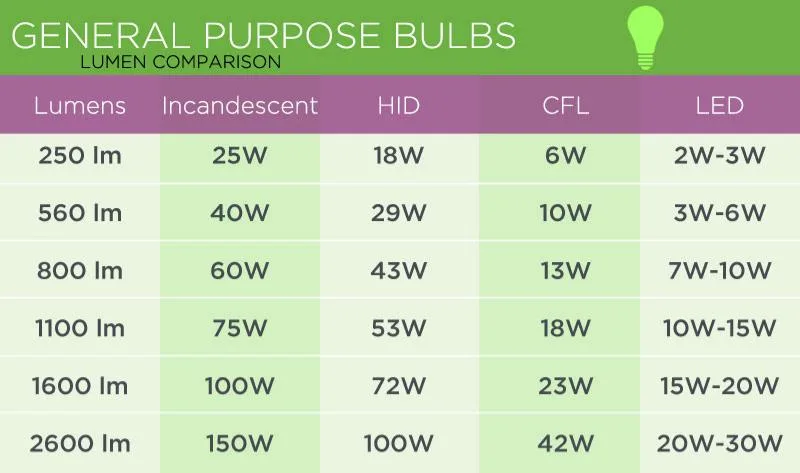
Lumens per Watt: The Missing Link Between Power and Brightness
While lumens describe light output and watts describe energy use, lumens per watt (lm/W) connect the two.
This metric is called luminous efficacy. It shows how efficiently a light source turns electrical power into visible light. A higher lm/W means more light for the same power input, which is why watts versus lumens is no longer a fair brightness comparison.
Typical efficacy ranges (lm/W) vary by technology and by how the value is measured.
In real projects, you should distinguish between source efficacy (LED package / lamp) and delivered (luminaire) efficacy (light leaving the fixture after optics, lenses, and thermal limits). This distinction is often missing in simple lumens and watts comparisons, but delivered lm/W is what truly matters in applications.
| Light source | Typical lm/W (range) |
| Incandescent | ~8–13 |
| Halogen | ~10–36 (type-dependent) |
| CFL | ~50–80 |
| Metal Halide | ~68–120 |
| LED (delivered) | ~50–175+ (product-dependent) |
These ranges are consistent with widely used lighting training material and industry overviews.
This is why wattage alone is not a fair comparison. Two fixtures can both be rated at 100 W, yet one can deliver much more usable light—simply because it has higher lm/W.
For engineers and specifiers, lm/W directly affects:
Lifetime energy cost and total operating budget
Heat generation and thermal design (lower watts for the same light usually means less heat stress)
Driver stress, reliability, and service life (thermal margin matters)
Solar panel and battery sizing (same illuminance with fewer watts)
Carbon footprint and sustainability reporting
In short: higher lm/W means lower power for the same brightness—and a better total cost of ownership.
From Lumens to Lux: Where Light Actually Reaches People
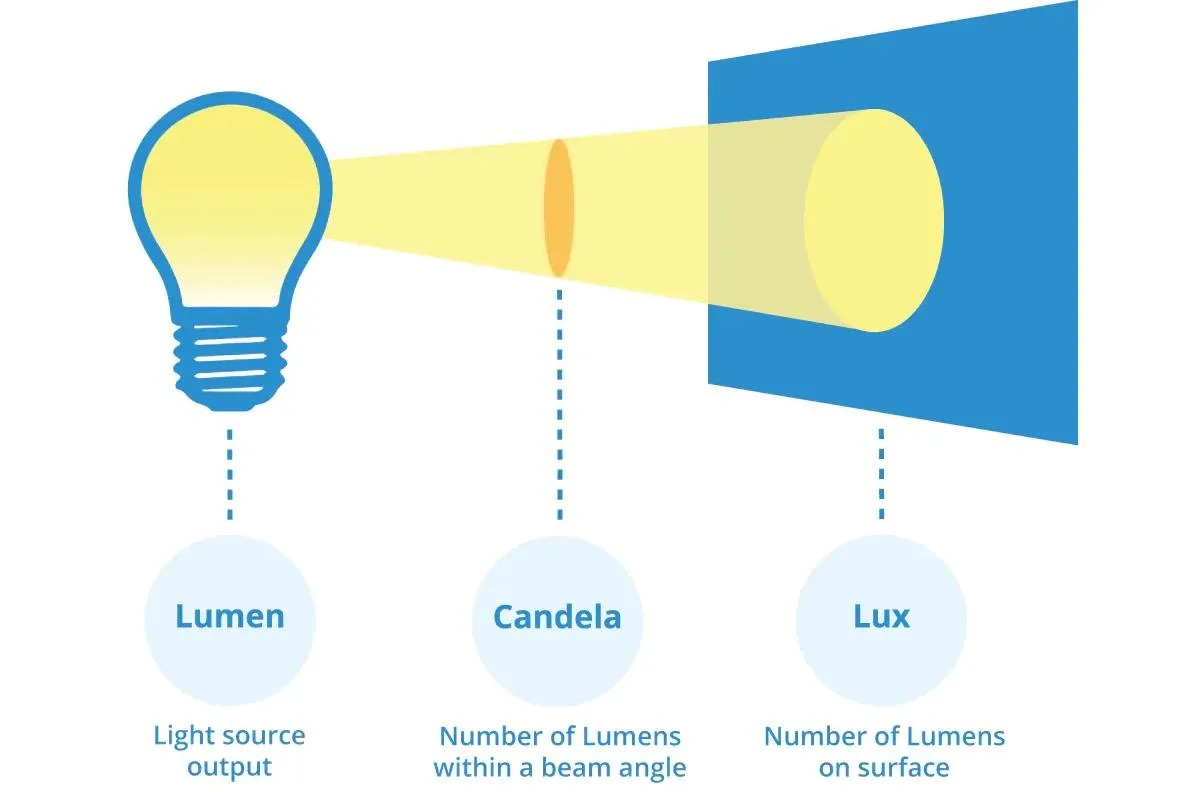
Lumens tell you how much light a source produces.
Lux tells you how much of that light reaches a surface.
So, lumens = total light emitted, and lux = lumens per square meter (lm/m²).This distinction sits at the heart of any watt vs lumen or lumens vs watts discussion, because lighting performance is judged on the work surface or roadway—not inside the fixture.
Understanding this difference explains what is the difference between lumens and watts in real projects A fixture can have a high lumen rating and still give poor results on site if the design is wrong. This can happen when the beam angle is not suitable, the mounting height is incorrect, light spills outside the target area, or glare makes the light less usable. Standards and roadway guidance treat glare control (often checked with methods such as UGR) and uniformity as key design factors because they affect what people can actually see.
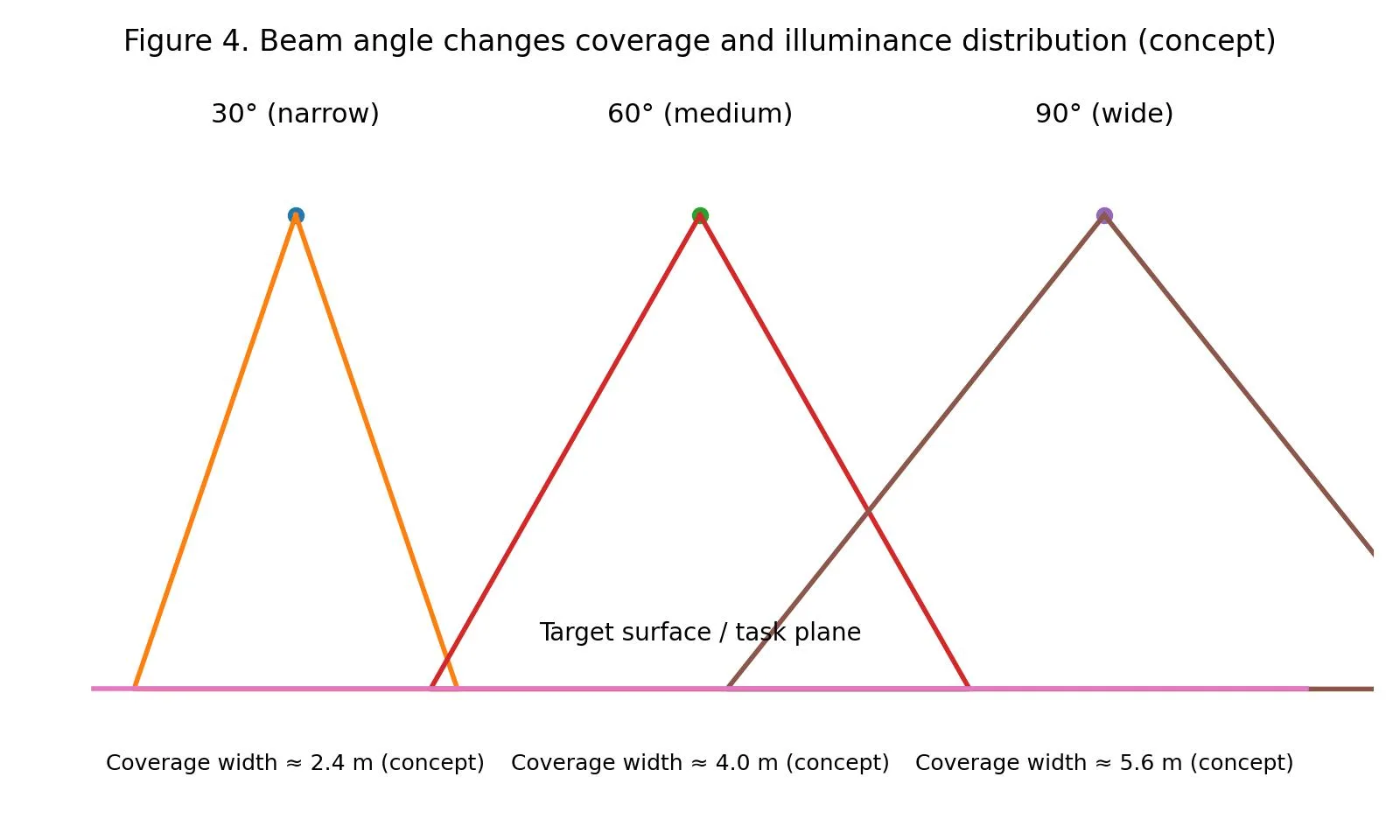
That is why professional lighting design follows a clear order: requirements → lux → lumens → watts. Designers first set the required illuminance (lux). Then they calculate how many lumens are needed on the surface. Next, they choose optics and layout—beam angle, spacing, aiming, and mounting height—to control light distribution and glare. Only after that do they check wattage, which clarifies efficiency in any comparison of lumens to watts and helps reduce operating cost.
Why “More Watts” Does Not Mean “Brighter” in LED Projects
A common mistake in lighting projects is thinking:
“If it’s not bright enough, increase the wattage.”
This often does not fix the real issue.
In many cases, poor lighting is not caused by “too few watts.” It is caused by design and optical problems. Common examples include low-efficiency optics, the wrong beam pattern, too much glare (which can reduce usable visibility), poor mounting height or spacing, and light spilling outside the target area. These issues usually show up in the candela distribution / polar curve in an IES file or LM-79 report, and in the isolux (false-color) map from Dialux/AGi32 calculations.
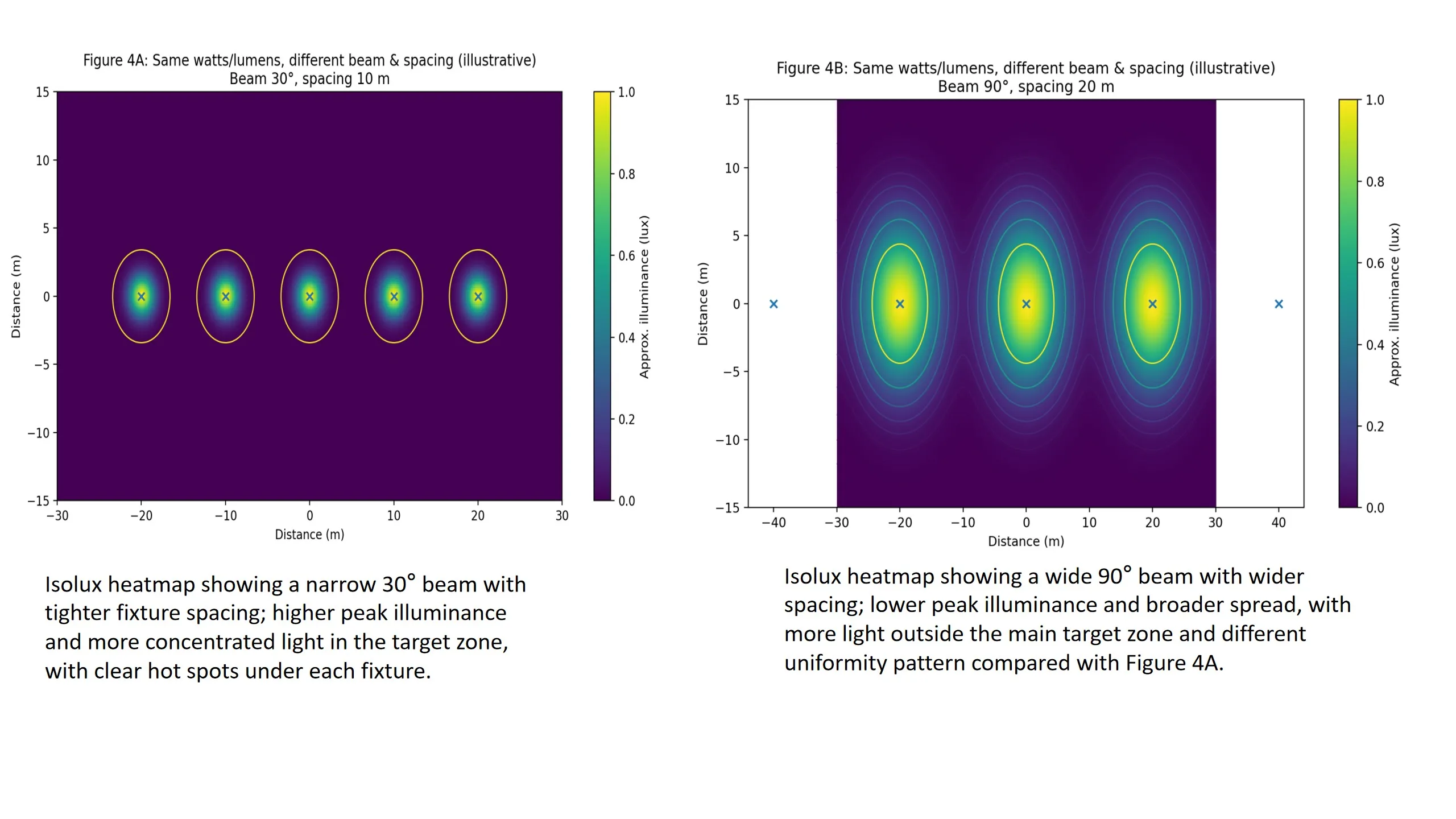
If you raise wattage without fixing the root cause, you usually increase cost, heat load, and maintenance risk—without improving visibility. This is why lumens versus watts LED comparisons matter: higher wattage does not guarantee better lighting performance.
A better engineering response is to improve the system first. Increase lumens only where they are needed. Use optics and distribution that keep light in the task zone. Adjust mounting height and spacing to improve uniformity. Choose the right beam angle for the application.
Power increase should be the last step, not the first. Start with optics, layout, and verified photometric results. Only add power if the calculations still show a real shortfall.This approach leads to more reliable outcomes in any lumens to watts comparison.
Incandescent vs LED: A Practical Retrofit Comparison
Consider a typical retrofit scenario.
| Fixture Type | Wattage | Lumens | Result |
| 100W Incandescent | 100 W | ~1,600 lm | Inefficient, warm |
| 100W LED Flood Light | 100 W | 15,000–18,000 lm | Industrial-grade brightness |
| 200W Metal Halide | 200 W | ~20,000 lm | High maintenance |
Here, wattage alone tells you nothing about performance.
Lumens—and how they are delivered—tell you everything.
This is why modern retrofits focus on matching lumens and lux, not matching watts.
Why Wattage Still Matters (Just Not for Brightness)
Lumens matter most for how bright an area looks.But wattage is still important in lighting system design.This balance sits at the center of the light bulb lumens vs watts discussion.
Wattage affects how much load a circuit can carry, breaker size and safety, transformer and cable choice, backup power and generator size, solar panel and battery size, and how much heat builds up inside the fixture.In watts vs lumen terms, watts define system limits—not visual performance.
In solar and off-grid lighting systems, wattage often decides whether the system can work at all.Lumens decide how well the area is lit.Good lighting design uses both.
Lumens meet the lighting need.Wattage keeps the system safe, reliable, and practical.This is the correct way to compare LED brightness and understand watts vs LED lumens in real projects.
How Professionals Specify Lighting Today
In modern B2B and municipal projects, good lighting design follows a clear process.
First, define the lighting task, such as a road, warehouse, yard, façade, or sports field.
Next, define the required illuminance in lux, based on IES, EN, or local standards.
Then calculate the required lumens using the area, mounting height, and expected losses.This stage focuses on lumens measurement and surface performance, not power.After that, choose the optics and light distribution so light goes only where it is needed.Finally, check wattage to balance efficiency and cost.This step-by-step method helps prevent over-design, poor lighting, and wasted energy.
FAQ
1.Is higher wattage always brighter in LED lighting?
No. In modern LED lighting, higher wattage does not always mean higher brightness. Brightness is measured in lumens, while wattage only shows how much electrical power a fixture uses. Two LED lights with the same wattage can look very different because of differences in lm/W efficiency, optics, and thermal design.
2.What is the difference between lumens and watts?
Watts measure how much energy a light uses. Lumens measure how much visible light it produces. This difference matters in real projects. Engineers use watts to plan circuits and power systems, while lumens determine how bright a space actually looks. Mixing these two often leads to poor lighting results.
3.How many lumens do I need instead of looking at watts?
The number of lumens depends on the lighting task, not on wattage. Designers first set the required lux level based on standards, then calculate lumens using the area, mounting height, and expected losses. Wattage is checked later. Starting with watts often causes overdesign or weak lighting.
4.Why can two lights with the same wattage look very different?
Because wattage does not describe how light is delivered. It does not account for lm/W efficiency, beam angle, glare, mounting height, spacing, or optical losses. This is why photometric data, such as IES files and isolux maps, is more reliable than wattage labels.
5.Does higher lm/W always mean better lighting?
Higher lm/W means better energy efficiency, but it does not guarantee better lighting quality. Good lighting still depends on optics, uniformity, glare control, and correct application design. lm/W is important, but it must be used as part of a complete lighting system.
6.Why do tenders still specify wattage if lumens matter more?
Wattage is still needed for system planning. It affects electrical limits, cable and transformer sizing, backup power, solar and battery design, and thermal reliability. Modern specifications usually require both lumens and wattage, because each supports a different engineering decision.
Final Answer: Which Is More Important?
Lumens matter most for brightness and visual performance.
Watts still matter for energy planning and system size.
In modern lighting projects, lumens come first.
They define how the lighting performs.
Wattage supports the system and its limits.
Lux then shows whether the lighting works in real use.
This difference is not just technical.
It is the difference between lighting that only uses power and lighting that truly works.
Conclusion
Wattage and lumens are not competitors.
They are tools for different decisions.
Watts show how much energy a system uses.
Lumens show how much light it produces.
Lux shows whether that light is useful in real conditions.
Modern LED lighting works best when all three are used correctly.
Projects that focus first on lumens and light distribution, and then adjust wattage, achieve better visibility, lower running costs, longer system life, and stronger return on investment.
That is why, in modern engineering practice, lumens matter more than watts—
but only when both are clearly understood.
Understanding watts, lumens, and lux is the first step.
Applying them correctly in a real project is where most designs succeed—or fail.
If you are working on a commercial, industrial, or municipal LED lighting project and want to:
Verify lumen and lux targets
Review photometric layouts (IES / Dialux)
Balance brightness, efficiency, and system limits
Avoid overdesign, glare, or wasted energy
Our engineering team can review your application and specifications from a system-level perspective.
Feel free to reach out for a technical discussion—no sales pressure, just practical lighting engineering.