Skip to content
sportsfield lighting is not decoration.It is a core system that affects safety, performance, and cost.In modern stadiums, led sports field lighting must serve athletes, spectators, and broadcast cameras at the same time. Poor lighting causes glare, dark zones, and high energy use. Good lighting creates clear visibility, comfort, and long-term reliability.This article explains sports field lights for stadium lighting in a simple, engineering-based way. It is written for project owners, engineers, and buyers who need clear decisions, not marketing language.
Why sports stadium led lighting Matters
Sport field lighting affects how games are played and seen.For athletes, lighting controls visibility, depth perception, and reaction time. In fast sports like football or soccer, uneven light makes it harder to judge ball movement and player position.For spectators, lighting must be even across the whole field. Bright spots and dark areas reduce viewing comfort and focus.For broadcasting, lighting quality is critical. Cameras need stable light, good vertical illumination, and accurate color. This is why professional football stadium lighting follows strict design rules.
Because of these combined needs, stadium led lighting must be planned as a technical system, not just a group of lamps.
Why LED Has Become the Standard for Stadium Lighting
Most modern stadiums now use LED field lights. This change is not only about energy saving.
LED lighting replaced traditional metal halide systems because it solves several long-term problems.
LED sports field lights use less power while delivering better visibility. They turn on instantly and do not need warm-up time. This is important for training sessions, events, and emergency use.
LED systems also last much longer. Fewer replacements mean lower maintenance cost, especially for high poles.
Most importantly, LED technology allows precise optical control. Light can be directed only to the field, not wasted into the sky or stands. This is a key reason LED has become the standard for stadium lighting.
Led lighting standards for stadiums and Sports Fields
Lighting standards exist to ensure safety, fairness, and visual comfort. While the specific numerical requirements vary by sport and competition level, the underlying principles are consistent across all professional guidelines.
Illuminance and Uniformity
Illuminance defines how much light reaches the playing surface. However, average brightness alone is not sufficient. Uniformity describes how evenly light is distributed across the field.
In football field lighting and soccer field lights, poor uniformity creates visual fatigue and misjudgment of ball movement. Well-designed lighting for sports fields prioritizes consistent illumination rather than isolated brightness peaks.
Horizontal and Vertical Lighting
Horizontal lighting measures light on the ground plane. Vertical lighting measures illumination on vertical surfaces, such as players’ bodies and the ball in motion.
Vertical lighting is particularly important in stadiums designed for broadcasting. Football stadium LED lighting systems must balance both dimensions to ensure players are clearly visible from all camera angles.
Glare Control
Glare is one of the most common complaints in poorly designed stadium flood lighting. Excessive brightness in the wrong direction reduces visibility instead of improving it.
Professional LED athletic field lighting uses controlled beam distributions, shielding, and precise aiming to minimize glare while maintaining required light levels.
Performance Metrics That Define Quality lighting sports fields
Effective sports lighting cannot be evaluated by wattage alone. Several performance factors work together to determine real-world results.
Optical Distribution and Beam Control
Beam angle selection determines how light spreads across the field. Narrow beams concentrate light for long throws, while wider distributions support overlap and uniformity.
In outdoor field lighting, optical design must match pole height, setback distance, and field dimensions. Poor beam selection leads to light spill, wasted energy, and uneven coverage.
Color Temperature and Color Rendering
Most stadium lighting systems use neutral to cool white color temperatures to enhance visual clarity. However, consistency matters more than the absolute value.
High color rendering improves depth perception and color accuracy, which is essential for both athletes and broadcast cameras. This is a key reason NFL lighting specifications emphasize color quality alongside brightness.
Stability and Flicker Control
High-quality LED outdoor sports lighting maintains stable output under varying electrical conditions. Flicker control is critical for high-speed cameras and slow-motion replay, even if it is not immediately noticeable to the human eye.
Designing Lighting for Different Sports Fields
Each sport places unique demands on lighting design. Treating all fields the same leads to compromised performance.
Football and Soccer Fields
Football field lighting requires long throw distances and strong vertical illumination. The size of the field, ball height, and speed of play demand careful aiming and overlap control.
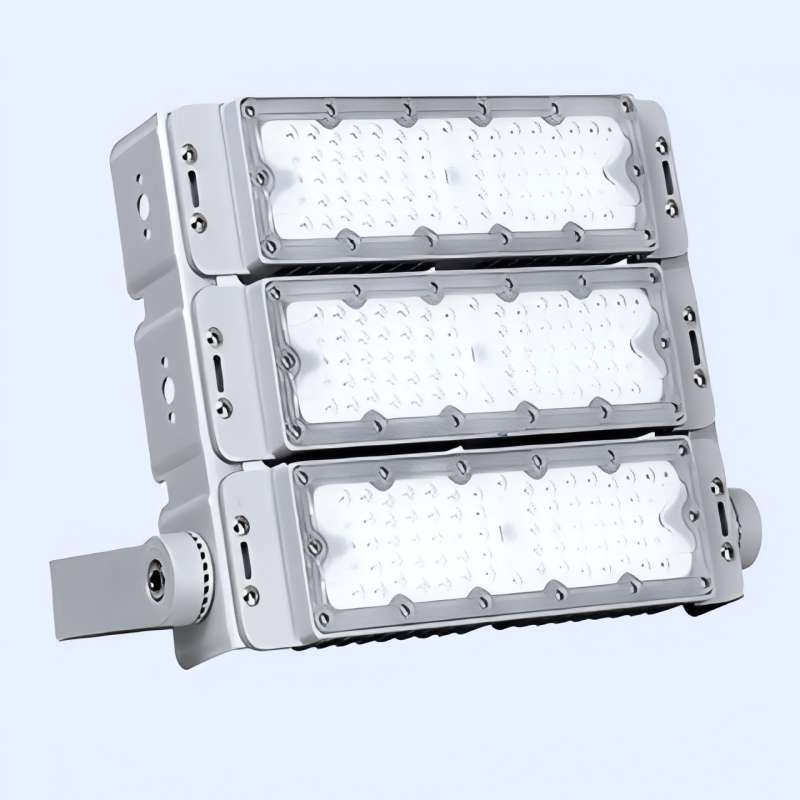
Modern football stadium led lights use multi-module optics to balance reach and uniformity without excessive glare. For soccer stadiums, lighting must also accommodate continuous play with fewer stoppages, making visual comfort over extended periods critical.
Baseball and Softball Fields
Baseball field lights for sale often require asymmetrical designs. The infield, outfield, and pitcher’s mound have different lighting priorities.
LED softball field lights must manage high vertical illumination for fly balls while avoiding glare for batters and fielders. This makes optical precision even more important than raw output.
Multi-Use Athletic Fields
Athletic field lighting for schools and community complexes often supports multiple sports. In these cases, flexibility, aiming accuracy, and controllability become more valuable than maximum brightness.
Energy Efficiency and Long-Term Operational Value
Energy consumption is a major cost driver for stadium owners. energy-saving led sports lights reduce electrical load while maintaining professional lighting quality.
Beyond energy savings, LED systems reduce maintenance disruptions. Fewer lamp replacements mean less downtime and lower labor costs, especially in facilities with high mounting heights.
Smart controls further improve efficiency by enabling scheduling, zoning, and dimming for training versus competition use. While advanced control systems vary by project, even basic zoning adds measurable operational value.
Over the life of a stadium, these factors often outweigh initial purchase price differences, particularly when evaluating affordable LED stadium lights USA solutions for public projects.
How to Choose LED Sports Field Lighting: A Buyer’s Perspective
Procurement decisions often fail when buyers focus on headline specifications rather than system performance.
Look Beyond Wattage and Lumens
High wattage does not guarantee good lighting. Poor optical design wastes light and increases glare. Well-engineered LED field lighting achieves better results with lower power through controlled distribution.
Evaluate Fixture Quality and Design
Thermal management, sealing quality, and structural durability determine long-term reliability. Outdoor stadium environments expose fixtures to wind, rain, heat, and vibration.
High-quality stadium LED lights maintain performance over time rather than degrading rapidly after installation.
Consider Supplier Capability
Sports lighting projects require more than products. Lighting calculations, aiming support, and post-installation adjustment are often necessary.
Choosing a supplier experienced in sportsfield lighting reduces project risk and ensures compliance with performance expectations.
Common Mistakes in Stadium Lighting Projects
Many underperforming installations share similar problems.
Some projects overspecify power instead of improving distribution. Others neglect glare control, leading to complaints despite high brightness. In some cases, inadequate planning results in costly retrofits shortly after installation.
Effective stadium flood lighting avoids these pitfalls by treating lighting as a system, not a collection of fixtures.
Final Thoughts: A System-Level Approach to Stadium Lighting
Sports field lights for stadium lighting must balance safety, performance, efficiency, and longevity. LED technology provides the tools, but results depend on engineering discipline and informed decision-making.
The most successful projects prioritize optical control, compliance with lighting standards, and long-term operational value. By focusing on system design rather than individual components, facility owners can achieve reliable, professional lighting that serves athletes, spectators, and broadcasters alike.
Well-designed stadium lighting is not about being the brightest. It is about being precise, consistent, and sustainable over time.